
Sewer Line Installation and Repair in Sulphur Springs, TX
Everything that goes down a drain in the house leaves through one pipe. When that pipe clogs, cracks, or sags, the trouble does not stay in one bathroom; it shows up everywhere at once. Waterford Plumbing handles sewer line installation and repair in Sulphur Springs, part of the full lineup of Waterford Plumbing services, from new lines for new houses to fixing the ones that have quit carrying waste away.
Drains backing up in more than one room? Stop running water in the house and call.
An Old Line That Keeps Failing
Where the Sewer Line Runs
Under the house, every fixture drain feeds into the building drain. Just outside the foundation, that pipe becomes the building sewer, which carries waste across the yard to the city main or, on many rural properties, to a septic tank. A cleanout, usually a capped pipe sticking up near the foundation, marks the point where the two meet and gives access for clearing the line.
In most towns, the property owner is responsible for the sewer line from the house to the connection at the city main. On a septic property, the line from the house to the tank belongs to the owner as well, while the tank and drain field are a separate system.
Signs the Problem Is the Main Line
A single slow sink usually means a clog in that sink. Trouble in the main line looks different. Several fixtures drain slowly at the same time. The toilet gurgles when the washing machine empties. Water rises in the tub or shower when someone flushes, because the lowest drain in the house is where a backup appears first.
Outside, a sewage smell near the cleanout, soggy ground along the path of the line, or a patch of grass that grows faster and greener than the rest of the yard can all mean the pipe is leaking underground.
What Damages Sewer Lines
Tree roots are a leading cause. They find their way into joints, especially in older clay tile pipe, and grow until they block flow or break the pipe apart. Soil movement is another. When ground settles under a section of pipe, it forms a low spot, called a belly, where waste collects and solids build up.
Pipe material matters too. Cast iron corrodes and scales from the inside over decades. Orangeburg pipe, a fiber pipe made from wood pulp and tar and used from the 1940s into the 1970s, softens and flattens under the weight of the soil. Grease poured down kitchen drains hardens inside any type of pipe and narrows it over time.
Seeing Inside the Pipe
Guessing at a sewer problem leads to digging in the wrong place. A camera inspection is the common way to find out what is actually going on: a waterproof camera on a cable is fed into the line through the cleanout, showing roots, breaks, bellies, and offset joints, along with how far from the house each one sits. A locator above ground can then mark the spot and depth before any excavation starts.
Repairing or Replacing the Line
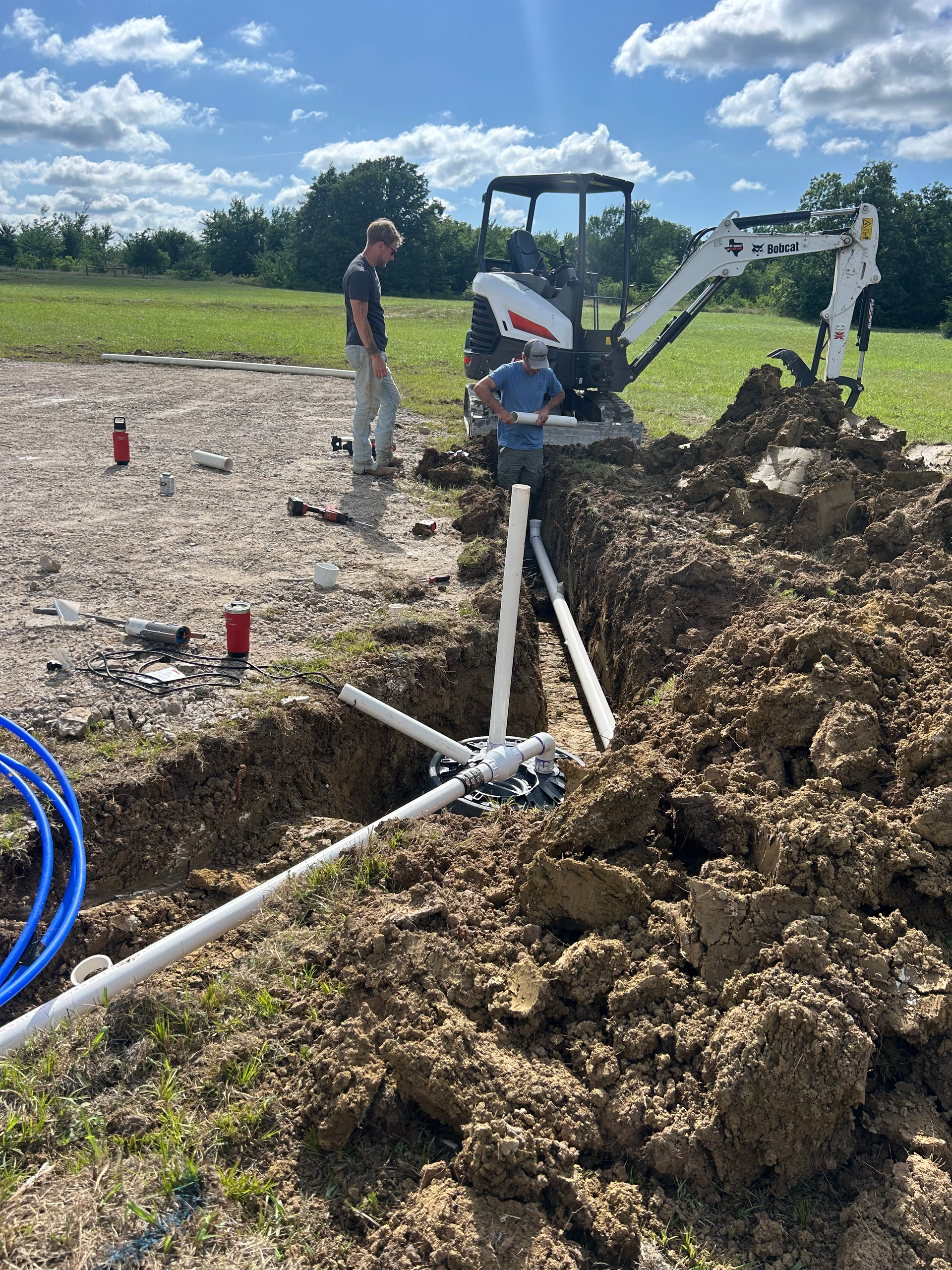
A single cracked joint or one root intrusion on otherwise sound pipe can often be fixed with a spot repair, digging only over the damaged section. A line made of Orangeburg pipe, or one with several bellies and breaks along its length, is usually better replaced than patched.
New sewer lines are installed as part of plumbing for a new home, and the route has to work alongside the water service. Plumbing code requires the sewer and the water line to be kept apart in the ground, which is one reason sewer and waterline installation are easiest to plan together.
Sewer Lines Outside Town
Around Cumby, Tira, and Commerce, many homes are on septic systems rather than city sewer. The line from the house to the tank faces the same roots, settling, and aging pipe, and it shows the same warning signs.
Sewer Line Questions
Who is responsible for the sewer line?
In most cities, the property owner is responsible for the line from the house to the connection at the public main, and the city maintains the main itself. On a septic property, the owner is responsible for the line, the tank, and the drain field.
What is a sewer cleanout?
It is an access point into the sewer line, usually a 3-inch or 4-inch pipe with a removable cap near the foundation. The International Plumbing Code requires a cleanout near the junction of the building drain and the building sewer, so the line can be cleared or inspected without pulling a toilet.
Why does my toilet gurgle when the washer drains?
Gurgling happens when draining water pushes air through the system instead of letting it move freely. It often points to a partial blockage in the main line or a problem with the vent, and it usually gets worse before a full backup.
How much slope does a sewer line need?
For 4-inch pipe, code sets a minimum slope of one-eighth inch per foot. Over a 100-foot run, that is a drop of about 12.5 inches from the house to the connection. Too little slope lets solids settle, and too much can let water outrun the solids.
How far apart do the sewer and water lines have to be?
The International Plumbing Code calls for 5 feet of separation in the ground between the water service and the building sewer. Exceptions apply in limited cases, such as a water line set on a shelf at least 12 inches above the top of the sewer.